Nul ne l'a telle, sa maistresse 3v · Basiron, Philippe
Appearance in the group of related chansonniers:
*Copenhagen ff. 9v-11 »Nul ne l'a tele, sa maistresse« 3v PDF – Facsimile
*Laborde ff. 13v-15 »Nul ne l'a telle, sa maistresse« 3v P. Baziron PDF – Facsimile
*Wolfenbüttel ff. 15v-17 »Nul ne l'a telle, sa maistresse« 3v PDF – Facsimile
Editions: Jeppesen 1927 no. 9 (Copenhagen); Gutiérrez-Denhoff 1988 no. 15 (Wolfenbüttel; faulty).
Text: Bergerette; full text in Copenhagen, Laborde and Wolfenbüttel; also in Berlin 78.B.17
f. 184v (no. 576) ed.: Löpelmann 1923 p. 358. After Laborde:
Nul ne l’a telle, sa maistresse, Au vray dire ce qu’il me semble, Tant belle et tant bonne est ensemble De son maintien regardons qu’esse, Nul ne l’a telle, sa maistresse, |
No one has such a woman, as his mistress, To tell in truth what appears to me, She is all at once so beautiful and so good Let us regard her manner as it is, No one has such a woman, as his mistress, |
1) Wolfenbüttel, lines 6-8, “tant belle et tant bonne est ensemble
/ Je ne vis oncques la pareille / car plus la voy, plus mesmerveille.”
2) Copenhagen, line 8, “que plus me voi …”
There are some differences in spelling in the sources.
Evaluation of the sources:
The three sources are so similar that this song may have been quite new and of limited circulation when it was copied into them. Also the time span between its entries into the sources may have been quite short.
Laborde seems to be a nearly perfect copy of its exemplar. Its only questionable trait is that it does not have a one flat key signature in the tenor like in the other two sources. In bar 8, however, it displays a natural before b, which might imply that the scribe simply forgot to write the signature, but the melodic line itself does not need a signature in bars 1-6 as it is impossible to sing anything else than b-flat during the tenor’s trudging back and forth between f and b – and thus the natural may come in as a precaution for the following. Laborde also places the repeat sign in the couplets at the same place in all three voices (in b. 56) ensuring a simple and effective return from the first to the second couplet. All three sources show a few insignificant variations in the use of coloration and ligatures, but Laborde also differs from the other two in some melodic details of greater importance (S b. 47; T bb. 2.3 and 54.2-55.1; C bb. 5, 6.3 and 17.3).
Copenhagen and Wolfenbüttel were copied from closely related exemplars. They both exhibit some scribal errors – the Wolfenbüttel scribe apparently did not recognize the musical and textual quote from Binchois’ »Je ne vis oncques« (see below) as he changed about lines 6 and 7 in the text and thereby broke the connection between music and text, and botched the rhyme scheme. Otherwise they are quite alike. E.g. both place the repeat sign of the couplet in the tenor after the note g and thus prolong the chord before the return.
Copenhagen like Laborde has a key signature of one flat in the first staff only of the contratenor, which Wolfenbüttel does not have. It does not make much difference in a performance.
Comments on text and music:
The lover and his heart praise their mistress in this exuberant bergerette, which is written in rich rimes (léonine, close to équivoque), and it was without doubt created by the composer himself while planning the shape of the music. The crucial point of the poem and the element upon which the text and music of the whole song was constructed, is a line “Je ne vis oncques la pareille”, which was lifted from a very widely circulated song of the preceding generation. The rondeau »Je ne vis oncques la pareille« appears with an ascription to Binchois in the Nivelle Chansonnier (no. 40) and anonymously in Laborde and Wolfenbüttel (no. 32 and no. 30 respectively), while it is ascribed to Du Fay in the slightly younger Italian source, Montecassino, Biblioteca del’Abbazia, MS 871. The emblematic first line of this rondeau (see example A below, bb. 1-5 of the superius) is quoted quite literally, but transformed into double time, as the second line of the bergerette’s first couplet (bars 40- 50; example B):
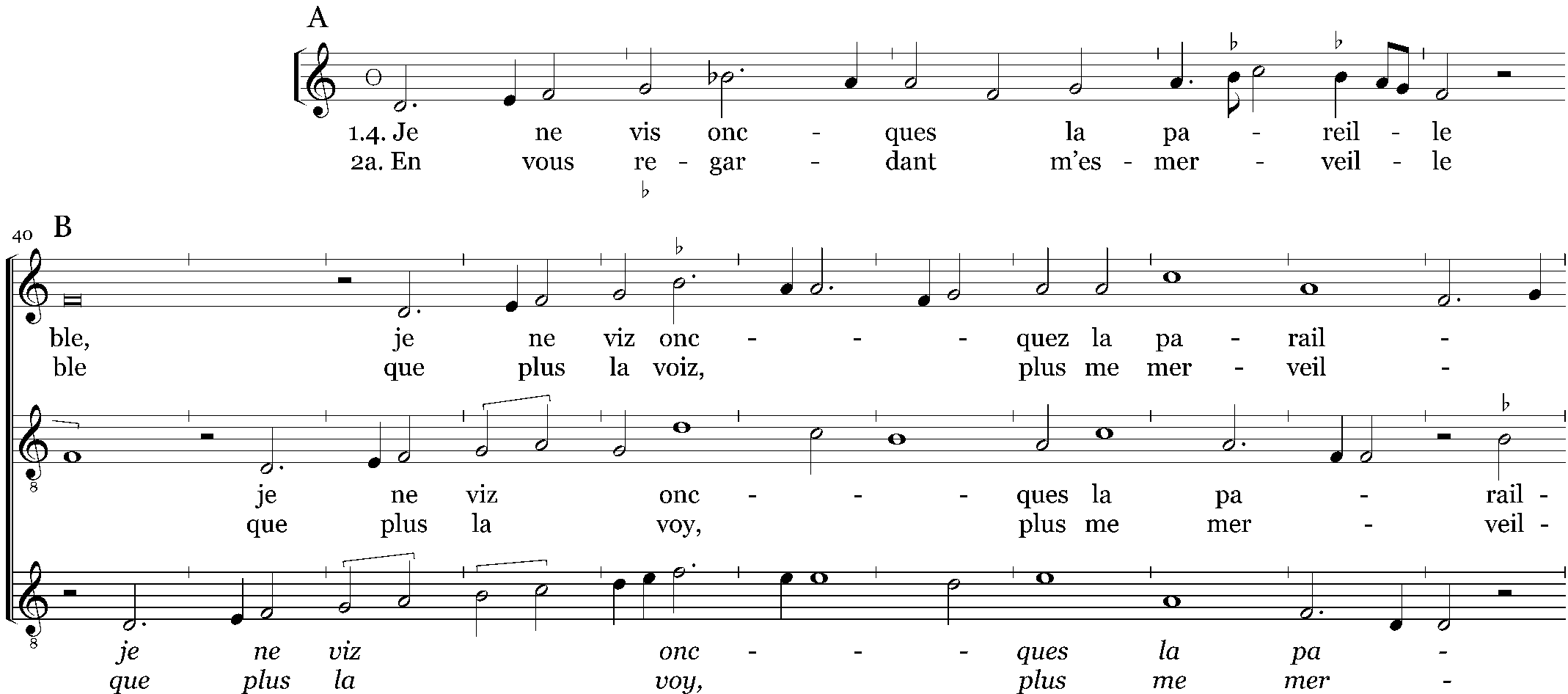
Moreover, the composer made the quote in his superius stand out by introducing it in a three-part imitation with the contratenor in the lead. After contratenor’s soaring line reaches its climax on “oncques”, the voices slide into a cadential progression in fauxbourdon-like style, which at once is relieved by staggered descending triads in all voices.
Otherwise, there is not much imitation in the setting, only between tenor and superius in bars 15-17 (a sort of octave canon), and fauxbourdon progressions seem to be the composer’s favourite way of cadencing (bb. 5-6, 11-13, 44-47, and 61-63). Accordingly the song’s contratenor lies above the tenor in many passages.
The formal layout of the setting conforms perfectly to the conventions of bergerette-settings in the Busnoys generation. It shows the clear contrast between the refrain/tierce section and the couplets by means of mensuration, namely tempus perfectum followed by tempus imperfectum diminutum, and the composer may also have intended a contrast between a tenor b-flat in the first section and none in the second, even if this will be obscured by the rules of performing the musical lines (it is more of a visual contrast than a contrast in sound). Furthermore the seconda volta (clos) of the couplets ends in a glittering flourish like many other songs of this type from around 1460. While the form seems up-to-date, the sound and technique of the song appear a bit dated.
In the Laborde chansonnier the song was ascribed to “P. Baziron” by a slightly later scribe (the so-called Index-Scribe II; cf. Alden 1999 p. 80) who also wrote similar ascriptions above two other chansons in Laborde: »Je le scay bien ce qui m’avint« (no. 7) and »De n’esjouir plus n’ay puissance« (no. 13) – both are also found in Wolfenbüttel. Philippe Basiron was between 1458 and 1474 associated the Sainte Chapelle of the royal palace in Bourges, as a boy chorister at first, and he ended up as magister puerum. (1) He must have been very young, when he composed it sometime in the 1460s, and this agrees very well with the style of “Nul ne l’a telle”, which is quite far from the technical maturity and precision of expression of its admired model, the rondeau by Binchois. And his song was apparently only circulated locally where musicians were familiar with the young talent.
The slightly younger French-Italian chansonnier in Sevilla, Biblioteca Capitular y Colombina, MS 5-1-43, transmits an anonymous bergerette with text incipits only, »Le bien fet«, which is an exact parallel to “Nul ne l’a telle” as regards the use of a quotation of all three voices from the first line of “Je ne vis oncques” as its second line of music in the couplets (see further the commentary). This song could enentually be an early attempt at the theme of “Nul ne l’a telle” by Basiron. A more credible explanation may be that the relative success of “Nul ne l’a telle” inspired a colleague to try his hand at something similar.
See also the article ‘The chansons of Basiron’s youth and the dating of the ‘Loire Valley’ chansonniers’.
PWCH December 2009, revised May 2013
1) Cf. Jeffrey Dean, ‘Basiron, Philippe’ in Grove Music Online (November 2009).